Blue sky with soft clouds
Military vehicle on a winding mountain road
How we do this

Four Ways We Build Executable
Continuity

Defense organizations can engage each capability on its own or as a complete program. Defense contractors can deliver the same capabilities to their clients
through a teaming arrangement.
Network diagram icon

Program Stand-Up and Sustainment

Ownership and roles, governance, decision rights, battle rhythm, sustainment cadence, handoff framework.

Checkmark icon

Validation and Exercises

Exercises designed and facilitated to test the program, followed by an after-action review and a corrective action plan your team owns.
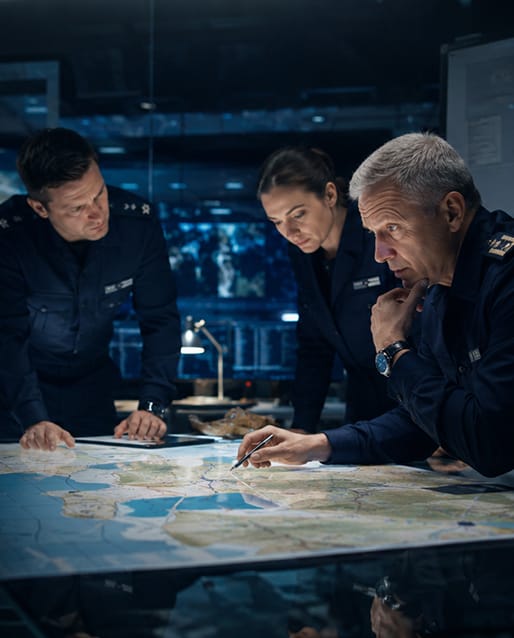
Officers reviewing a map together at a planning table in an operations room
Clipboard checklist icon

Decision-Ready Continuity Outputs

Sustain and restore priorities, dependency logic, triggers and thresholds, decision packages leaders can understand, brief and act on.
Team members icon

Teaming and Partnership

Certified defense continuity practitioners deliver the work under your contract vehicle while you keep the client relationship.
Continuity
How Engagements Can Be Structured

Choose the Fastest Path to Executable Capability

Mobile air defense radar and missile launcher positioned on a coastline

Option A: Baseline and Priorities (Short)

Define mission-critical priorities, decision ownership, and the first set of leader-usable outputs. Designed for organizations that need clarity in 60 to 90 days.

Best for: Inherited programs, urgent clarity needs, upcoming assessments.
Navy destroyer cutting through rough seas

Option B: Command-Level Buildout (Standard)

Build decision-ready outputs across leader priorities and operational dependencies. Validate through exercises.

Best for: Commands requiring a complete, exercise-validated program.
Armored vehicles crossing a floating pontoon bridge over a misty river

Option C: Validation Sprint (Targeted)

Stress-test what exists. Surface execution failure points before they surface under real conditions.

Best for: Mature programs that pass assessments but do not execute with confidence.
Fighter jet and service members on an airfield
Fighter jet on the flight line at night
Officials reviewing maps on an illuminated planning table

Frequently Asked Questions

Questions Leaders Ask.

Why do most defense continuity programs fail?

Because they were designed for the assessment, not for the disruption. The program manager holds the role as a collateral duty without the training or methodology to build something that will execute under real conditions.

What does “executable continuity capability” mean?

Continuity that functions under real-world constraints: limited people, compressed time, degraded communications, sustained mission pressure. Leadership decides and staff executes without external support.

How is this different from traditional continuity consulting?

Traditional consulting produces compliance artifacts. Vision Continuity operationalizes continuity into executable capability: decision-ready outputs your organization owns and sustains after the engagement ends.

Will the program be maintainable independently?

Yes. Capability transfer is the engagement model. You own all deliverables. The program is designed to survive leadership turnover. No licensing fees. No ongoing support requirements.

How long does a typical engagement take?

Most command-level engagements range from 6 to 18 months depending on scope and maturity. Option A (Baseline and Priorities) can deliver initial clarity in 60 to 90 days.

What happens after the engagement ends?

You continue operating and improving your continuity program using the methodology transferred during the engagement. The methodology is in the outputs, not in the consultant.

Can you support classified continuity work?

Yes. Most foundational continuity work occurs at the unclassified level. When classified access is required, Vision Continuity supports delivery through cleared prime contractor partnerships.

How do engagements typically start?

Request a capability brief. We assess current state, clarify outcomes, and scope an engagement tailored to your mission. Most capability briefs take 30 minutes.

Can you work with existing continuity programs?

Yes. We assess what exists, identify the execution gaps, and synchronize documentation into an executable capability model. 

What do you mean by “real-world constraints”?

Limited people. Compressed timelines. Degraded communications. Sustained mission pressure. Key personnel absent. Decisions required in the first hour by someone who may have held the role for fifteen minutes.

How do you measure success?

Can leadership make continuity decisions during disruption without calling for external support? Can staff execute without consulting a plan they have never used? Does the program hold when tested?

What is required from our organization?

Command leadership engagement for priority decisions, continuity program owner coordination, and business function owner participation for operational validation.

How do I request a capability brief?

Use the “Request a Capability Brief” button or contact us directly.

Leaders seated around a conference table in a command center